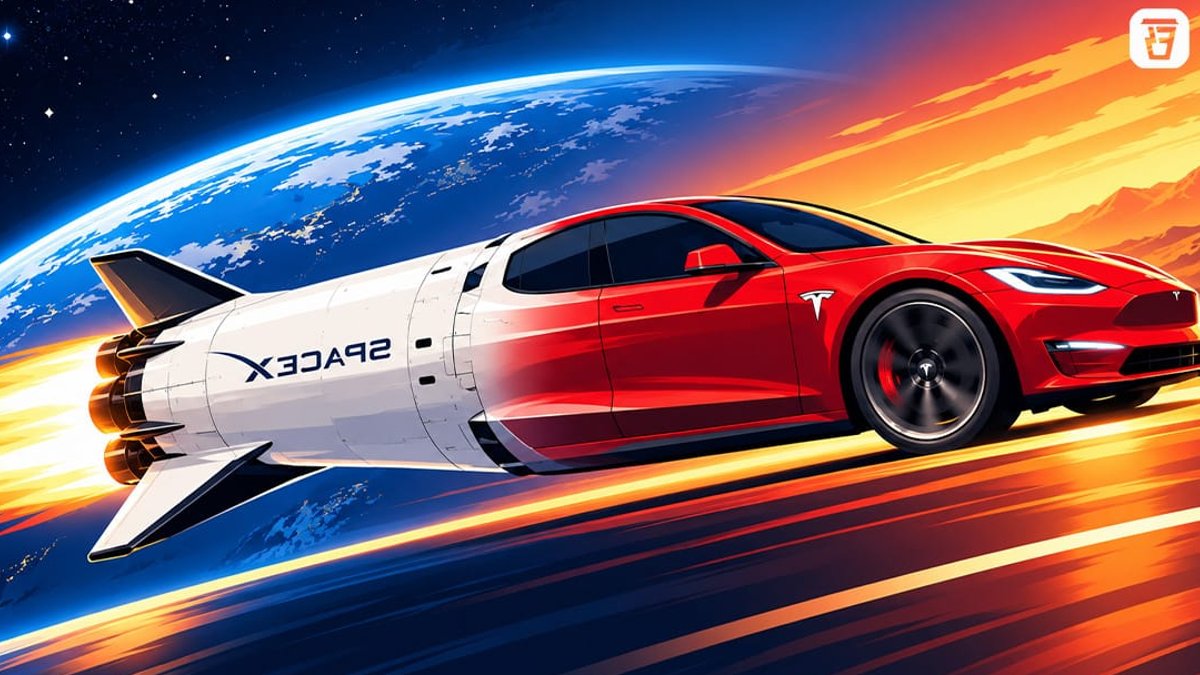
Talk of a Tesla SpaceX merger surged after Elon Musk displayed a new Roadster equipped with brief rocket-thruster flights. The spectacle hinted at more than a novelty; it suggested deeper integration between his two flagship companies.
Musk pitches a $3.5 trillion combine
Musk publicly endorsed merging the electric-car maker with the launch firm, estimating the joint entity could be worth roughly $3.5 trillion. The deal could create a conglomerate worth roughly $3.5 trillion, with businesses spanning electric vehicles, rockets, satellite internet, artificial intelligence, robotics and computing infrastructure.
Both companies are already blurring lines. Tesla is pouring resources into autonomous driving, humanoid robots, battery tech and AI, while SpaceX is expanding beyond launches into large-scale computing and its own AI initiatives.
Financial ties have deepened. SpaceX-owned xAI bought about $430 million in energy-storage systems, and SpaceX itself purchased another $143 million in Tesla vehicles. Earlier this year, Tesla placed a $2 billion stake in xAI, which was later converted into SpaceX shares, giving the carmaker a small direct holding in the launch company.
Recent earnings illustrate divergent pressures. Tesla’s net profit fell 46 percent in 2025 to roughly $3.8 billion, while revenue hovered near $95 billion. In contrast, SpaceX reported about $14.6 billion in revenue and $4.4 billion in profit for the third quarter of 2026, plus more than $50 billion in cash and equivalents.
Those cash reserves could underwrite the carmaker’s long-term AI and robotics programs, which demand massive capital. Conversely, Tesla’s manufacturing scale and expertise in battery storage could accelerate the launch firm’s plans for larger satellite constellations and ground infrastructure.
One concrete overlap is the planned Terafab semiconductor plant in Texas. The facility is slated to produce chips for Tesla’s vehicles and robots, as well as for SpaceX’s satellite payloads, giving the combined group tighter control over critical hardware.
Read Also: Rectangles, card heist, and the human love of straight lines
AI collaboration offers another connection. Tesla requires enormous computing power and real-world driving data to train its Full Self-Driving software. xAI is building its own models and data centers. Merging these efforts could let physical data from the carmaker’s fleet feed directly into xAI’s training pipelines.
Governance and shareholder hurdles
Ownership structures add complexity. Musk holds roughly 20 percent of Tesla and about half of SpaceX’s shares, controlling around 85 percent of voting rights. Aligning valuation, share-exchange ratios and control mechanisms will require careful negotiation to satisfy both sets of investors.
Approval of the deal faces a high threshold. Tesla’s charter demands support from holders of at least 50 percent of all outstanding shares, not merely a majority of votes cast. Unvoted shares effectively count against the proposal, raising the bar for any merger to proceed.
The upcoming Roadster is slated for production in 2028, though past launches suggest the schedule may shift. Musk highlighted the vehicle as a showcase for integrating propulsion technology across his ventures.
Strategic rationale behind a unified effort
Musk argues that pooling capital, engineering talent, and manufacturing capacity could accelerate progress on multiple fronts. By sharing resources, both firms might avoid duplicating research on similar technologies.
Board composition and investor scrutiny
Three of Tesla’s nine directors maintain notable links to Musk’s broader business network. Kimbal Musk occupies a seat on Tesla’s board, while Ira Ehrenpreis chairs both the compensation and governance committees. Ehrenpreis also joined SpaceX’s board in February of that year, retaining his independent director role at the carmaker.


