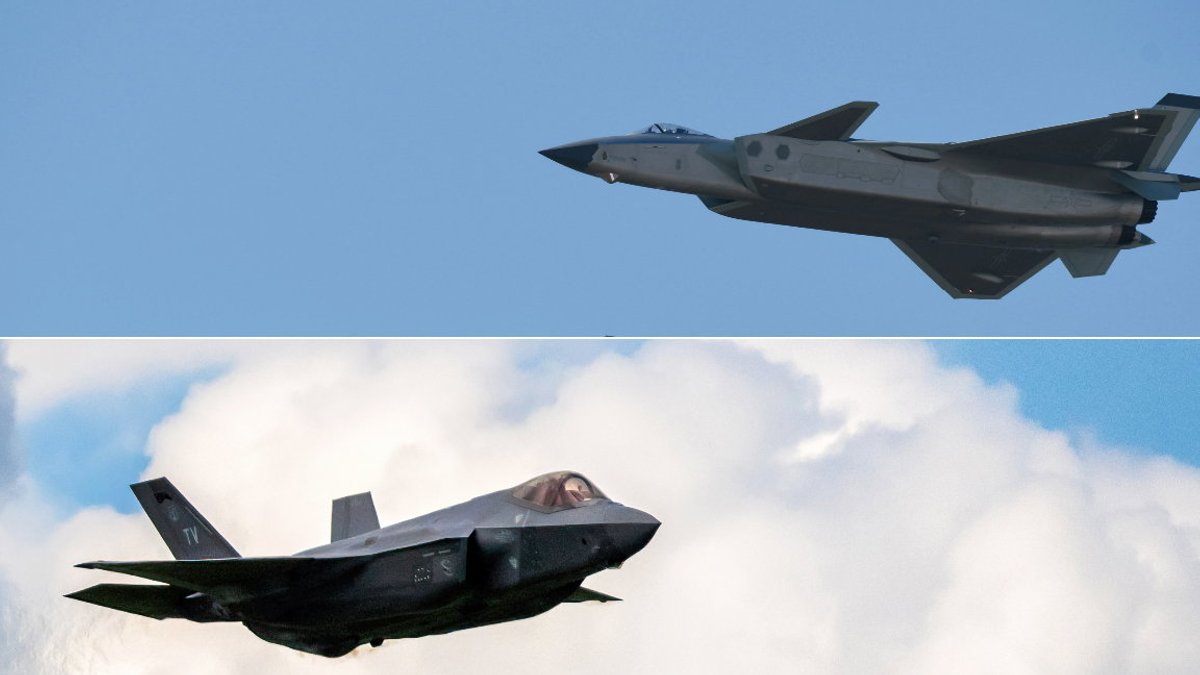
The F-35 Lightning II represents the pinnacle of American stealth technology, developed from the Joint Strike Fighter initiative. This program was specifically designed to create a multirole aircraft that could be exported to international allies and used by different branches of the military.
The F-35A variant, which entered service in 2016, relies on a combination of strategic cell geometry and specialized materials to evade detection. Its physical shape alone reduces its radar signature to approximately 0.06 square meters, while the application of radar-absorbing coatings further reduces this profile to an impressive 0.0001 square meters.
Comparison with the J-20
In contrast, the Chinese Chengdu J-20 marks the country’s first foray into fifth-generation aviation. Unlike previous Chinese fighter jets, which were largely inspired by Soviet designs, the J-20 is a more original design, albeit a secretive one.
Entering service in 2017 and mass-produced since 2020, this aircraft is primarily focused on air superiority.
In terms of design, the two aircraft differ significantly in size and configuration. The F-35 is a compact, single-engine aircraft with supersonic air intakes without deflectors to conceal its engine fans, as well as serrated edges to deflect radar waves.
Read Also: US startup to extract uranium from seawater
Performance and Capabilities
The J-20, on the other hand, is significantly larger, measuring approximately 21.5 meters in length, and uses a profiled fuselage combined with delta wings and canards for improved stability.
The F-35’s primary advantage lies in its electronic warfare and sensor integration capabilities. Its advanced toolkit, including the AN/APG-81 radar and a distributed aperture system, combines various data streams into a single view for the pilot, significantly enhancing situational awareness.
The J-20 has its own AESA radar and infrared tracking systems, but the extent of its sensor fusion capabilities remains to be verified due to a lack of transparent data.
In terms of performance, the J-20 has a significant advantage in terms of speed and endurance. Powered by domestically produced WS-15 engines, it can reach Mach 2 and potentially achieve supercruise at Mach 1.8, while its 2D thrust vectoring system provides superior agility.
It also has a range of 2,000 kilometers, far exceeding the F-35A’s range of 1,250 kilometers and its maximum speed of Mach 1.6.