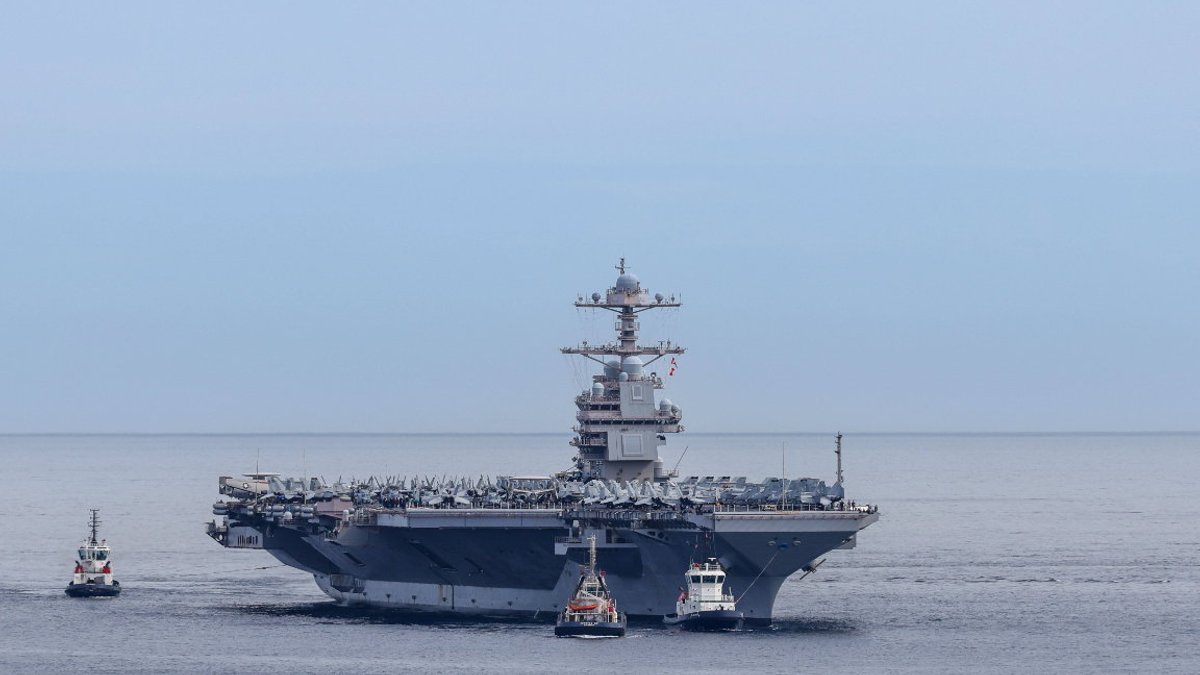
The US Navy’s next nuclear-powered aircraft carrier, the CVN-82 USS William J. Clinton, has now begun its preparatory phase. Huntington Ingalls Industries (HII) received a $336 million non-definitive contract to start procuring long-lead materials through its Newport News Shipbuilding (NNS) division. These funds cover essential propulsion components, which are vital for keeping the shipyard’s production timeline intact for the fifth vessel in the Gerald R. Ford class.
This procurement step represents the first major move for the CVN-82, which will take over from the aging Nimitz-class carriers as part of broader fleet modernization efforts. The contract reflects a strategic effort to secure supplies early, ensuring a smooth transition after the CVN-79 USS John F. Kennedy completes its sea trials in 2024. The Kennedy, the second ship in its class, is currently in its final pre-delivery assessment phase before entering operational testing.
Bryan Caccavale, vice president of program management at NNS, stated that obtaining these materials is critical for building the world’s most advanced carriers. The Clinton is set for launch in 2025, following the Doris Miller (CVN-81), which may introduce changes in propulsion technology. A Trump administration directive is prompting the Navy to consider replacing the Ford-class’s advanced electromagnetic aircraft launch system (EMALS) with traditional steam catapults and hydraulic elevators, beginning with the Miller. While the Kennedy (CVN-79) and Enterprise (CVN-80) will retain their current designs, the Miller could become a test case for older technology.
Read Also: Trump administration narrows “capture” definition in endangered species law
This shift in specifications reveals ongoing challenges in naval procurement. The Ford class was engineered for speed and efficiency, but rising costs and technical hurdles have led to reassessments. The Navy plans to acquire the Clinton in fiscal year 2028, with advance funding allocated over 2026–2027. By locking in materials now, NNS aims to maintain progress while finalizing earlier ships in the series.
The Clinton will be the sixth carrier in the Ford class, continuing a program that began with the Gerald R. Ford (CVN-78) in 2017. Its construction supports the Navy’s goal of maintaining an 11-carrier fleet by 2030, though earlier delays have strained production capacity. A potential change in propulsion technology could further disrupt timelines, as modifying systems mid-build is rare in shipyard operations.
For now, the priority remains material procurement. The $336 million contract includes reactor coolant systems and propulsion shafts—components that require years to produce. NNS has already started ordering steel plates and specialized alloys to ensure the Clinton’s hull and superstructure proceed without supply chain disruptions. The shipyard’s ability to manage multiple carriers simultaneously will determine whether the program stays on its accelerated schedule.