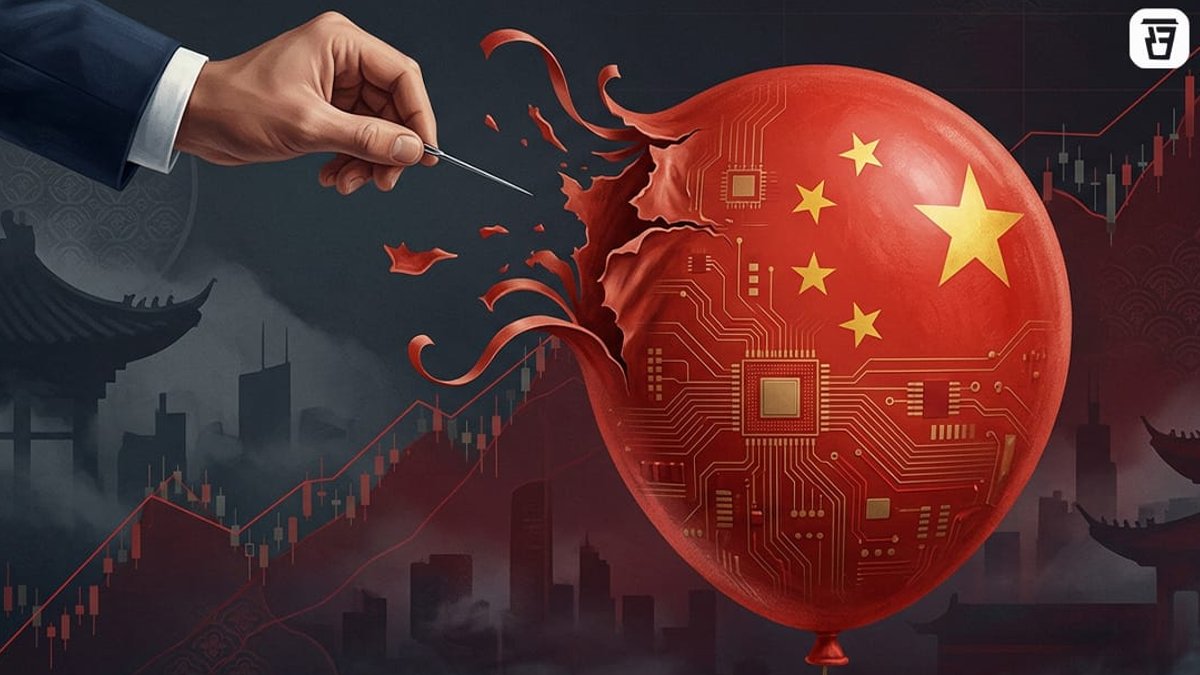
Artificial intelligence has become a major point of contention on financial markets, with analysts debating whether it represents an unprecedented speculative bubble or a transformative technological revolution akin to the internet era. While US investors maintain confidence in AI’s potential, as evidenced by the Nasdaq’s steady performance, China’s AI market has already experienced a dramatic correction.
The country’s STAR 50 index, comprised of leading AI-related stocks, has plummeted by 40% over the last four months, erasing roughly $480 billion in shareholder value. This steep decline serves as a cautionary tale about the risks when speculative enthusiasm clashes with fundamental economic realities. To comprehend the situation, it’s necessary to examine how the global AI expansion unfolded.
When OpenAI introduced ChatGPT in late 2022, major US technology firms reacted with urgency, fearing they would miss out on a defining technological shift. Companies like Amazon, Google, Meta, and Microsoft responded by allocating billions to construct data centers equipped with specialized AI processors. These facilities required substantial computational power, necessitating advanced chips capable of executing vast numbers of calculations simultaneously. A significant portion of these chips originated from a single manufacturer: Nvidia.
China’s AI Bubble Bursts
The surge in demand for these chips primarily benefited Nvidia, whose annual revenue surged nearly fivefold in just two years. Meanwhile, cloud providers and semiconductor firms have accumulated $3.7 trillion in combined debt and off-balance-sheet leasing obligations to fund data center construction. However, a fundamental issue persists: the staggering costs of developing and maintaining AI infrastructure demand substantial revenue streams to justify the expenditures. Industry estimates suggest that generating adequate returns on hardware investments would require approximately $600 billion in annual revenue. Yet, projections indicate that global spending on generative AI applications will reach only $64 billion this year.
The first significant warning sign appeared during what Wall Street dubbed “AI’s Black Monday.” When DeepSeek, a relatively obscure Chinese research laboratory, unveiled its open-source reasoning model, it demonstrated that high-performance AI systems could be developed at a fraction of OpenAI’s costs using older-generation hardware. As a result, Nvidia’s market valuation dropped by $600 billion in a single trading session, as investors questioned whether massive computing investments remained essential.
China’s AI sector has already endured this market correction, with the STAR 50 index losing 40% of its value. The collapse stems from Beijing’s aggressive approach to stimulating its AI market, with state-backed investment funds channeling capital into domestic chip manufacturers, robotics firms, and AI research institutions. In a market heavily influenced by retail investors, government support functioned as an implicit endorsement, prompting millions of individual traders to purchase AI-related securities. This created an unsustainable speculative frenzy.
At its peak, AI stocks constituted 42% of China’s total market capitalization and accounted for 57% of all trading volume. Many companies within the STAR 50 index were valued at nearly 250 times their annual earnings. Such extreme valuations made them vulnerable to even minor setbacks. A case in point is Unitree, a state-backed developer of humanoid robots, whose stock price halved following its first earnings report post-IPO, revealing a 17% decline in net profits alongside doubled research expenditures.
Other domestic chip manufacturers have similarly seen their market values cut in half since July, while optical component producers Zhongji Innolight and Eoptolink experienced 60% declines amid concerns that US sanctions could restrict Chinese hardware in American data centers. The broader challenge facing Chinese AI enterprises revolves around intensifying price competition, which threatens to compress margins as companies vie for market dominance with diminishing returns.
This scenario mirrors past technological overinvestment cycles. In 1996, the introduction of Wavelength Division Multiplexing enabled fiber-optic cables to transmit 16 data streams simultaneously instead of one. Telecom firms, anticipating exponential internet growth, borrowed approximately $500 billion to deploy vast cable networks globally.
A critical distinction exists between fiber-optic infrastructure and today’s AI systems. While buried cables retain value over decades, AI hardware depreciates rapidly as more efficient processors become available. If computing capacity outpaces actual demand, the cost of accessing that capacity could plummet, potentially triggering a global reassessment of AI investments—with China’s $480 billion market correction serving as an early indicator.
How to Protect Your Finances With Insurance
The first session takes place on Tuesday, November 3, at 7:30 PM. It covers life insurance, how to protect your family, and choosing the right cover amount. The second session happens the next day at 7:30 PM. It focuses on health insurance, hospital claims, and avoiding common policy mistakes.


