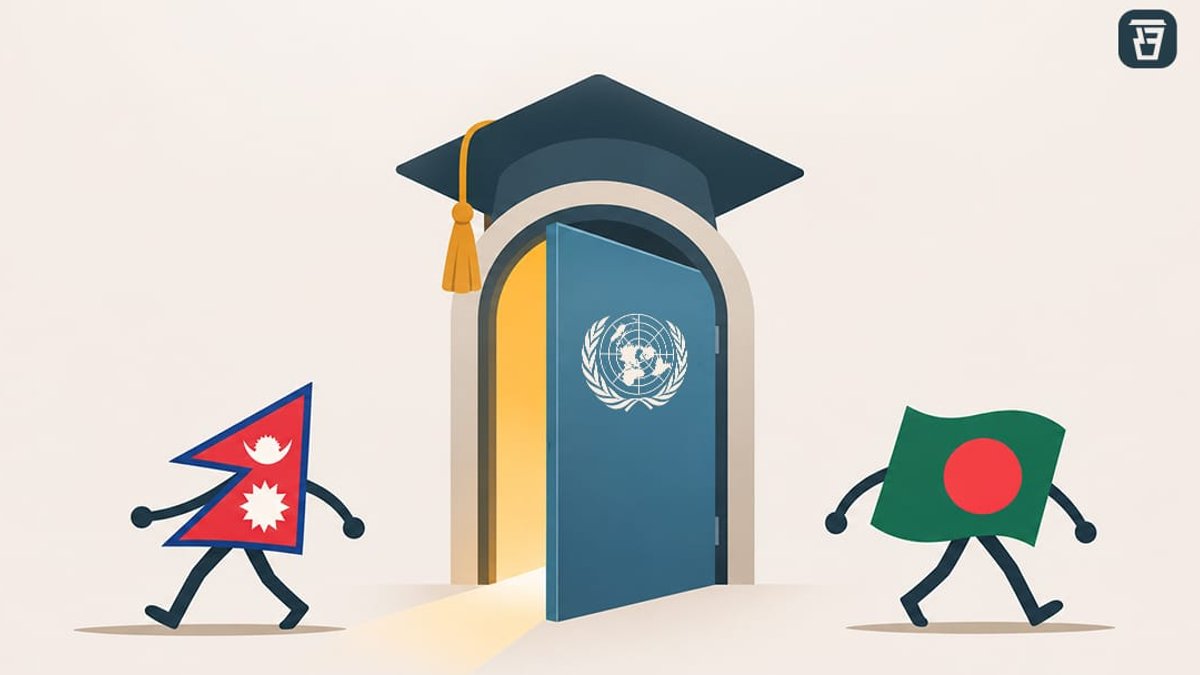
Why would a country ask to stay least developed?
The UN’s Graduation Criteria
The United Nations created the category of Least Developed Countries (LDC) in 1971 to identify nations facing significant development challenges. The label is not based solely on income, but rather on three specific indicators: Gross National Income per capita, Human Assets, and Economic and Environmental Vulnerability. If a country crosses a GNI threshold of $1,306 and meets or exceeds the other two benchmarks, it qualifies for graduation. Since the category began, only nine nations, including Botswana and the Maldives, have successfully graduated.
Despite meeting these technical criteria, Bangladesh and Nepal have asked the UN to delay their exit from the list. On October 29, the UN General Assembly agreed to grant them an additional three years, postponing their official graduation to November 2029. This decision has sparked debate over whether the countries are genuinely unprepared or if they are strategically retaining the economic advantages that come with the LDC status.
Retaining the LDC label provides access to preferential market terms, such as reduced or zero tariffs on exports to developed nations. For Bangladesh, which relies heavily on the garment sector—accounting for roughly 80% of its merchandise exports—these preferences are critical. Estimates suggest that about 73% of its exports currently benefit from LDC-specific treatment. Without them, exporters could face average tariff increases of 12.5%, potentially costing the economy more than $17.5 billion annually.
Nepal faces a different but still significant challenge. While its trade with India is protected by a bilateral treaty, it still risks losing preferential access to other markets and forms of international support. If we were to put a number to it, the potential export losses in the EU could account for less than 5% of Nepal’s total exports. But that doesn’t mean Nepal has nothing to worry about.
Both nations also face internal economic fragilities. Bangladesh’s government revenue is only about 6.8% of its GDP, leaving little room for infrastructure investment. Capital goods imports, a proxy for business investment, have fallen from $5.1 billion in 2019 to $2.8 billion in 2024. Nepal’s economy grew by just 3.9% in FY26, a decline driven by political unrest and weather-related disruptions. Nepal, meanwhile, is dealing with a different set of issues. Remittances account for roughly a third of its GDP, which means its economy depends heavily on money sent home by citizens working abroad. So any disruption to employment or economic activity in countries where Nepalis work, particularly in the Gulf, can affect household incomes and domestic spending back home.
Both governments have requested extensions before, citing previous crises like the COVID-19 pandemic and the 2015 Nepal earthquake. Bangladesh has signed trade agreements with Japan and South Korea to secure duty-free market access, but these have not yet taken effect. Nepal has struggled to negotiate alternative trade arrangements with major partners like China, the US, and Japan. Bangladesh had already received an extended five-year preparatory period because of the pandemic. And Nepal had previously secured an extension after the devastating 2015 earthquake.
The Challenge Ahead
While it is tempting to view the delay as a reluctance to grow, the reality is more complex. Both countries have made substantial progress; Bangladesh was the only nation to meet all three graduation criteria in the UN’s 2018 and 2021 reviews. Nepal has consistently met the human assets and vulnerability criteria, and later the income criterion in 2025. The issue is not a lack of development, but a lack of resilience. Their economies have not yet strengthened enough to withstand the loss of international support.
Both nations also face a unique hurdle: their populations are much larger than those of previous graduates. This scale makes the transition significantly more difficult. To avoid another extension in 2029, Bangladesh must focus on diversifying beyond garments and enforcing existing trade agreements, while Nepal must improve its infrastructure spending and leverage hydropower exports to India. The three-year extension offers a temporary reprieve, but the test of whether these countries can stand on their own economic feet is fast approaching.


