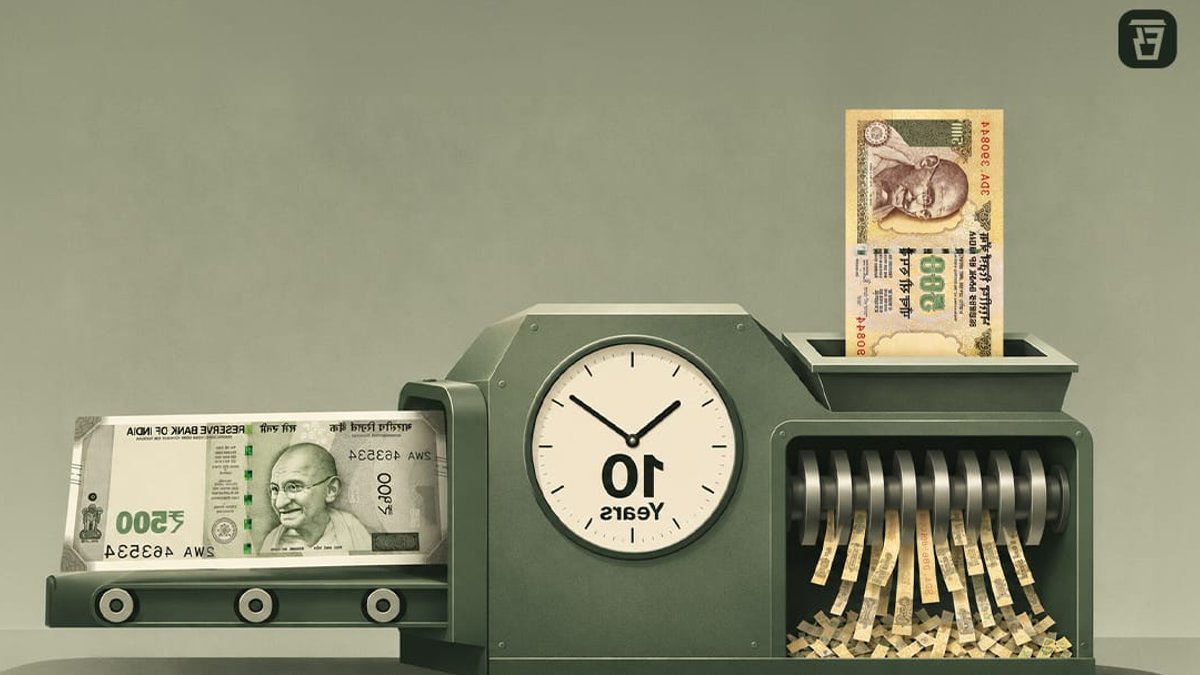
On November 8, 2016, India’s government announced the demonetization of ₹500 and ₹1,000 notes, removing ₹15 lakh crore from circulation. The decision aimed to tackle black money, eliminate fake currency, and widen the tax net. This move left many confused about how to handle their high-value notes, leading to long queues at ATMs as people scrambled to withdraw smaller denominations like ₹100 notes, the only ones available at the time.
A decade later, data reveals mixed outcomes. While 99.3% of the banned notes were returned, indicating limited impact on black money, the number of counterfeit notes detected per crore fell from 70 in FY16 to 13 in FY26. Notably, only ₹10,720 crore did not return, far below the expected ₹4-5 lakh crore in black money that was anticipated to remain unaccounted for.
Demonetization’s Impact on Black Money and Counterfeits
The government’s primary goal was to target black money, assuming it was held in cash. However, individuals with untaxed income often invest in real estate, gold, or shell companies. The Reserve Bank of India (RBI) had warned that demonetization would likely have a minimal effect on black money and counterfeit notes. This was evident as the majority of the banned notes were deposited back into the banking system, showing that black money was not primarily held in cash.
A closer examination of the data shows that fake ₹500 notes per crore decreased from 167 before demonetization to 20 today. Yet, counterfeit notes were never a major issue, and the economic losses from demonetization may outweigh the benefits of reducing them. The RBI’s data highlights that counterfeiting was a minor problem, making the drastic measure of demonetization seem disproportionate to the issue.
Shift to Digital Payments and Tax Filing
Demonetization did encourage a move toward digital payments, with the Unified Payments Interface (UPI) system gaining popularity. The number of people filing tax returns increased, partly due to traceable cash deposits linked to Permanent Account Number (PAN) records. However, the introduction of the Goods and Services Tax (GST) in 2017 and the wider use of Tax Deducted at Source (TDS) also played significant roles in this trend.
Related Post: Foreign investors pull out over ₹3 lakh crore from Indian
The 2017 Economic Survey found that new filers had an average income of ₹2.7 lakh, just above the tax threshold, and direct tax collections as a percentage of GDP fluctuated over the years. While demonetization may have played a role in increasing tax filings, other factors, such as the pandemic, also influenced the shift to digital payments and the subsequent rise in tax collections.
The National Payments Corporation of India (NPCI)’s plan to introduce a fee for UPI transactions above ₹2,000 could lead some small businesses to revert to cash transactions, potentially impacting the progress made in digital payments. This shift could slow the momentum gained in digital adoption, especially in rural and informal sectors.
Long-Term Effects on Cash Circulation and Counterfeiting
Despite the rise of digital payments, cash remains prevalent in India. The amount of cash held by the public has more than doubled since demonetization, now standing at around 12% of GDP. This persistence is partly due to India’s growing GDP and the continued reliance on cash for transactions like real estate purchases, weddings, and payments in rural areas.
Counterfeit notes, though reduced, remain a concern. While the overall detection rate per crore notes fell from 70 in FY16 to 13 in FY26, the focus on high-denomination notes reveals a different picture. The number of fake ₹500 notes per crore increased from 0.3 to 20 after demonetization. However, comparing the old ₹500 notes from before demonetization to today’s notes shows a decrease from 167 to 20 per crore. This comparison is key, as FY17, the year of demonetization, is not a valid baseline due to the introduction of new notes, which take time to be counterfeited.
Economic Impact and Future Considerations
Demonetization’s economic impact was significant, with an estimated 1.5-2% loss in output. The informal sector, heavily reliant on cash, was particularly affected. The move also failed to significantly curb black money, as most untaxed income is held in assets like real estate and gold.


